Author: Steve Chase
The hidden cost of owner labor — and the questions I think every inflatable rental operator should ask occasionally.
I’ve been thinking lately about how easy it is for business owners to discount the value of their own time.
You get another delivery and think, I’m already going that direction. I’ll just do it.
A customer is outside your normal delivery area. I can squeeze that in.
None of those decisions seems like a big deal. That’s probably part of the problem.
When you own the company, your own labor has a funny way of becoming invisible.
Apparently, the easiest employee to convince to work for free is the one who owns the company.
If your business only makes money because you are willing to work for free, the business may not be as profitable as it looks.
OWNER LABOR IS STILL LABOR
Let’s say you rent an inflatable for $300 and think, Not bad.
But that inflatable didn’t magically get itself from the warehouse to somebody’s backyard and then roll itself back onto the shelf Monday morning.
Somebody answered the call, scheduled it, loaded it, drove the truck, set it up, came back, tore it down, hauled it back, unloaded it, and maybe cleaned it.
But the labor doesn’t disappear because the owner did it.
If delivery, setup, and pickup took three hours, at $20 an hour that’s already $60 in labor before fuel, vehicle expense, payroll costs, or warehouse time.
The rental may still be profitable. But now we’re looking at the real picture.
I’ve started thinking of this as a replacement-cost test:
Would this rental still make financial sense if I had to pay somebody else to do everything I’m doing?
Load it. Deliver it. Set it up. Pick it up. Clean it. Answer the phone.
If the answer is no, maybe it’s pricing. Maybe the delivery area is too large for that order. Maybe you need a higher minimum. Maybe the route makes no sense or the inventory doesn’t have the margin you thought it did.
That’s useful information.
OWNER HUSTLE CAN HIDE A LOT
Owners are weird employees.
“It’s only one more stop.”
“I’ll go back tonight.”
“I can squeeze this delivery in.”
We’re emotionally invested, so we stretch.
But owner hustle can hide what it actually takes to run the company.
Then you hire somebody and think, Man, payroll is expensive.
But maybe the employee didn’t make the job expensive.
Maybe hiring the employee finally exposed what the job had been costing all along.
You just weren’t paying yourself for it.
And there’s another side to making yourself the hardest-working employee in the company.
What happens when that employee can’t show up?
IF YOU’RE YOUR BEST EMPLOYEE, YOU MAY ALSO BE YOUR BIGGEST SINGLE POINT OF FAILURE
This is a physical industry.
We drive trucks. We lift, pull, roll, move, clean, set up, tear down, and work in the heat. People get hurt. People get sick. Life happens.
If the owner gets injured, needs surgery, has a family emergency, or simply can’t work for a few weeks, the company may lose a lot more than “the owner.”
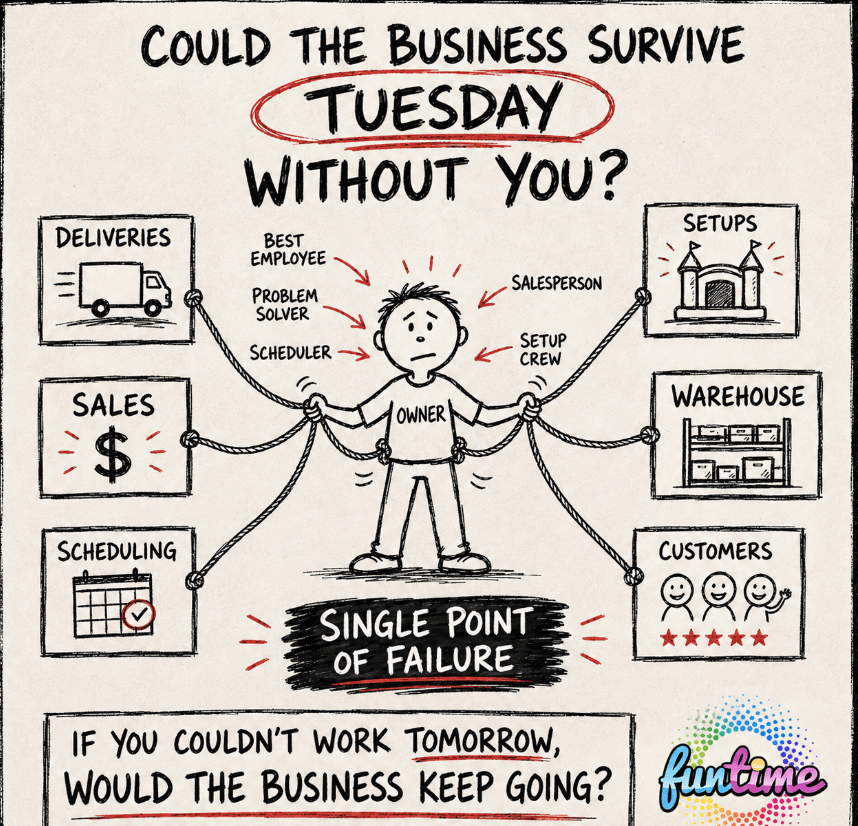
You may have just lost your best delivery person, your most experienced setup person, your scheduler, your salesperson, your problem solver, and possibly the person who knows how half the business actually works.
That’s not just a staffing issue.
That’s a company that may be way too dependent on one person.
And I don’t think we need to sit around worrying about every horrible thing that could happen. But I do think there’s a worthwhile question here:
Could this business still operate if I couldn’t work for the next 30 days?
That’s a different test than asking whether the business is profitable.
And the answer may tell you something about where you need training, systems, backup people, or simply another person who knows how to do what you do.
DONE IS BETTER THAN PERFECT
There’s another trap: nobody does it exactly like we do.
And you know what? We’re probably right.
They won’t.
I have to remind myself of one of my own rules:
Done is better than perfect.
That doesn’t mean sloppy is acceptable. Safety matters. Quality matters. Customers matter.
But if a trained employee can do the job safely, correctly, and professionally, it doesn’t need to be done exactly the way I would have done it.
“Exactly how Steve would do it” is not really a scalable operating procedure.
And there’s another reason this matters now.
Teaching somebody else to do something well isn’t only about freeing up your Saturday or getting yourself out of the truck.
It creates another person who can do the job if you can’t.
If the company only works when the owner personally touches every delivery, setup, customer problem, and decision, we haven’t built much of a system.
Employees have a different relationship with the business. That doesn’t mean they don’t care. They accepted a job. They didn’t buy the company.
We should be able to create jobs where good employees can do quality work without skipped breaks, endless overtime, or “just one more hour.”
In our industry, that matters. People are driving trucks, moving heavy equipment, working in heat, and making decisions that affect customers and safety.
TICK-TOCK. EVERY SECOND COUNTS.
Anybody who knows me has probably heard me say:
Tick-Tock. Every second counts.
I usually mean it as a reminder not to waste time. But I’m realizing there’s a business version too.
Every one of those seconds has a value.
And the owner’s time is worth more than what we would pay an employee. There’s also what we didn’t do because we were busy doing something else.
Maybe you spend three hours handling a low-margin delivery and pickup.
Maybe that really was the best use of your time.
But maybe you just spent three hours saving $60 in labor while not following up on a $3,000 event.
What didn’t I do because I was in the truck?
Could I have followed up with a school or corporate customer? Trained somebody? Fixed a scheduling problem? Reviewed pricing? Built a system that saves us hours every weekend?
Sometimes driving that truck absolutely is the best use of your time.
But there’s a big difference between:
“I’m doing this because it is currently the best use of our resources.”
and:
“I’m doing this because I’ve always done it.”
Those are not the same thing.
PRICE FOR THE COMPANY YOU WANT TO BUILD
If you eventually want delivery crews, warehouse employees, office staff, or managers, your pricing has to leave room for those people to exist.
But whatever company you’re trying to build, the numbers eventually have to work without depending on free labor from the owner.
So maybe we shouldn’t only price rentals for the company we have today.
Maybe we should also ask:
Could these prices support the company I’m trying to build?
And now I think there’s another question that belongs right beside it:
Could the company survive Tuesday without me?
Not someday when you’ve built some giant operation.
Tuesday.
If you wake up tomorrow and simply cannot be there, do the deliveries still go out? Can somebody solve a problem? Does somebody else know what needs to happen next?
The goal isn’t to make the owner unnecessary.
I think the goal is to build a company where the owner can decide where his or her time creates the most value instead of being the only person keeping the machine running.
I’m going to ask myself these questions more often, because I’m pretty sure there are jobs I’ve called profitable that might look different if Steve wasn’t the free labor.
So the next time you finish a rental and think, That was pretty profitable, try one more calculation:
Would it still be profitable if I had to pay somebody else to do everything I just did?
And while you’re at it, ask one more:
Could the business keep going if I couldn’t do it tomorrow?
The answers might tell you more about your business than the price on the invoice.
ABOUT THE AUTHOR
Steve Chase is an entrepreneur and co-owner of Funtime Events, a party and event rental company serving the Naperville, Illinois area. He writes about entrepreneurship, business systems, growth, and the lessons that come from actually running businesses and occasionally discovering a better way to do things.
Steve Chase
Funtime Events
st***@*************es.com